top of page

Brand Identity
Harvard Rare Disease Hackathon
A biotechnology student-led initiative dedicated to raising awareness and fostering innovation for underserved rare diseases. The team consists of Harvard undergraduates collaborating with the National Organization for Rare Disorders (NORD) to advance practical, meaningful, and lasting change for patients with rare diseases.
• Logo suite
• Fonts
• Colors

The Challange
The challenge was to create a professional yet welcoming visual identity that could resonate with two distinct audiences: students motivated by scientific discovery and social impact, and sponsors seeking meaningful opportunities to support innovation and emerging talent. The identity needed to attract participants and sponsors, raise awareness for underserved rare diseases, and communicate the hackathon’s role in advancing solutions across the patient journey without appearing overly playful, juvenile, or clinical.


The Solution
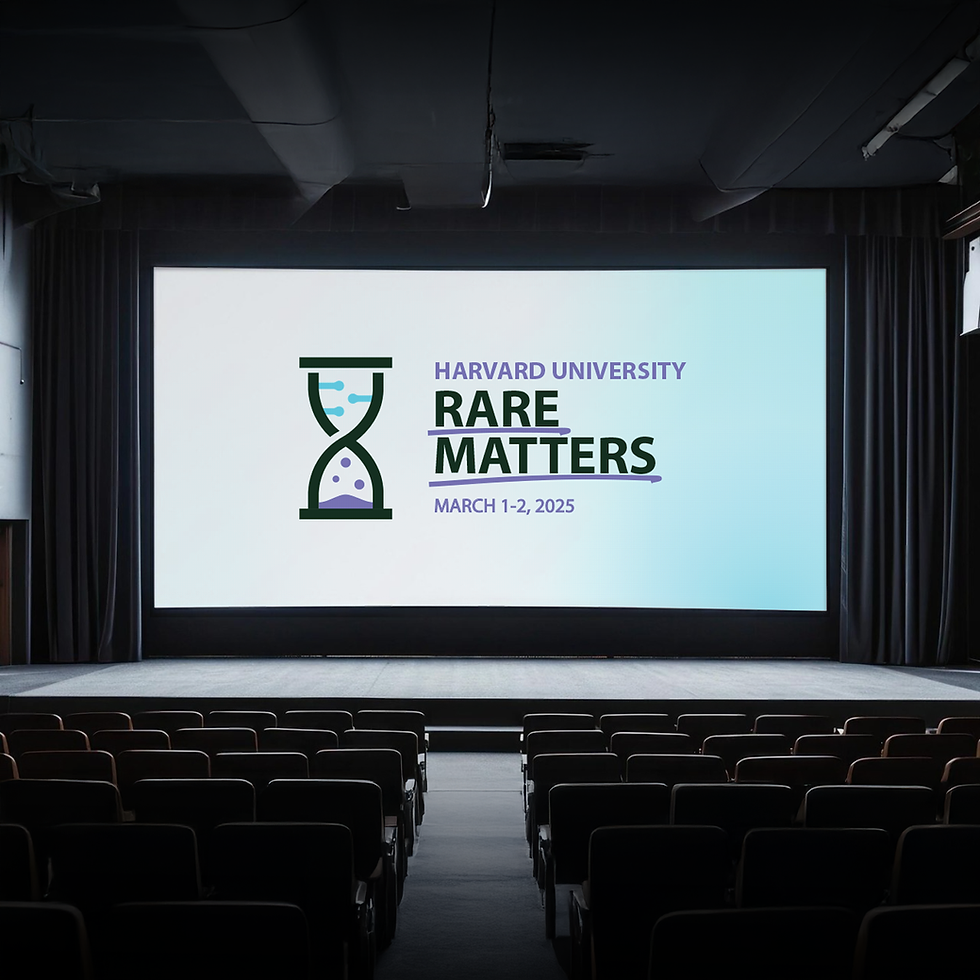
The strategy balanced scientific rigor with empathy, positioning the hackathon as an inclusive environment where innovation is driven by purpose and real patient needs. The redesigned logo centers on a DNA strand to represent biotechnology, while the connected dots symbolize rare disease and the human impact behind scientific advancement. Its hourglass form communicates the time-sensitive nature of the hackathon and incorporates a shield-inspired shape that connects the initiative to Harvard.
A bold yet inviting typeface reinforces alignment with NORD, while a dark green foundation and interchangeable blue and purple accents establish a modern palette suited to the health and technology industries. Together, these elements create a cohesive and adaptable identity designed to work across event materials, participant communications, and sponsorship packages.
The Results
Following the 2025 redesign, participant reach grew by 186.5% (from 67 to 192), while university reach expanded by 487.5% (from 8 to 47). Participants included undergraduate and graduate students from prestigious institutions such as Harvard, University of Pennsylvania, MIT, Tufts University, the University at Buffalo, the University of California, Michigan State University, Simmons University, Columbia University, George Washington University, and Washington University in St. Louis.
This redesign also played a pivotal role in establishing the NORD Scholarship Program, which helps reduce financial barriers for students committed to rare disease research. The program has supported 54 students across 18 universities.
186.5%
increase in participant reach
487.5%
increase in university reach
54 students
supported via scholarships from sponsors
bottom of page